Content
Executive summary
Enterprises must deliver higher performance under increasing constraints: complex operations, limited resources, and rising competition.
Traditional Operational Excellence improves individual functions but struggles to coordinate decisions across the enterprise.
Enterprise Orchestration addresses this challenge by coordinating decisions, processes, and resources across the organization so it operates as one coherent system.
By coordinating all decisions and activities across a company’s value chain, we directly address the systemic inefficiencies caused by strict departmentalization and rigid business rules.
Enterprises today operate under increasing pressure to remain relevant in complex and evolving markets.
Competitive intensity continues to rise: margins compress, service expectations increase, and capital efficiency is scrutinized more closely. A 2024 Accenture study found that supply chain disruptions have caused businesses to miss an estimated $1.6 trillion in annual revenue growth, highlighting how much value remains locked within the complexity of large-scale operations.
At the same time, resources are becoming more constrained. Scarcity is no longer an exception, but a structural condition: expertise is limited, infrastructure takes years to expand, and capacity cannot scale on demand.
This tension defines the current reality: enterprises must continuously outperform their peers while operating with the same or fewer resources. The path forward is clear: performance must come from extracting more value from existing systems rather than relying on expansion.
At enterprise level, the objective is clear: long-term profitability, meaning the sustained ability to create value over time within competitive and resource constraints. We refer to this as Enterprise Profitability.
In theory, every operational decision could be optimized against this objective. In practice, this becomes unmanageable for large enterprises due to three structural realities:
The number of interdependent decisions
The complexity of their interactions
The speed at which conditions change
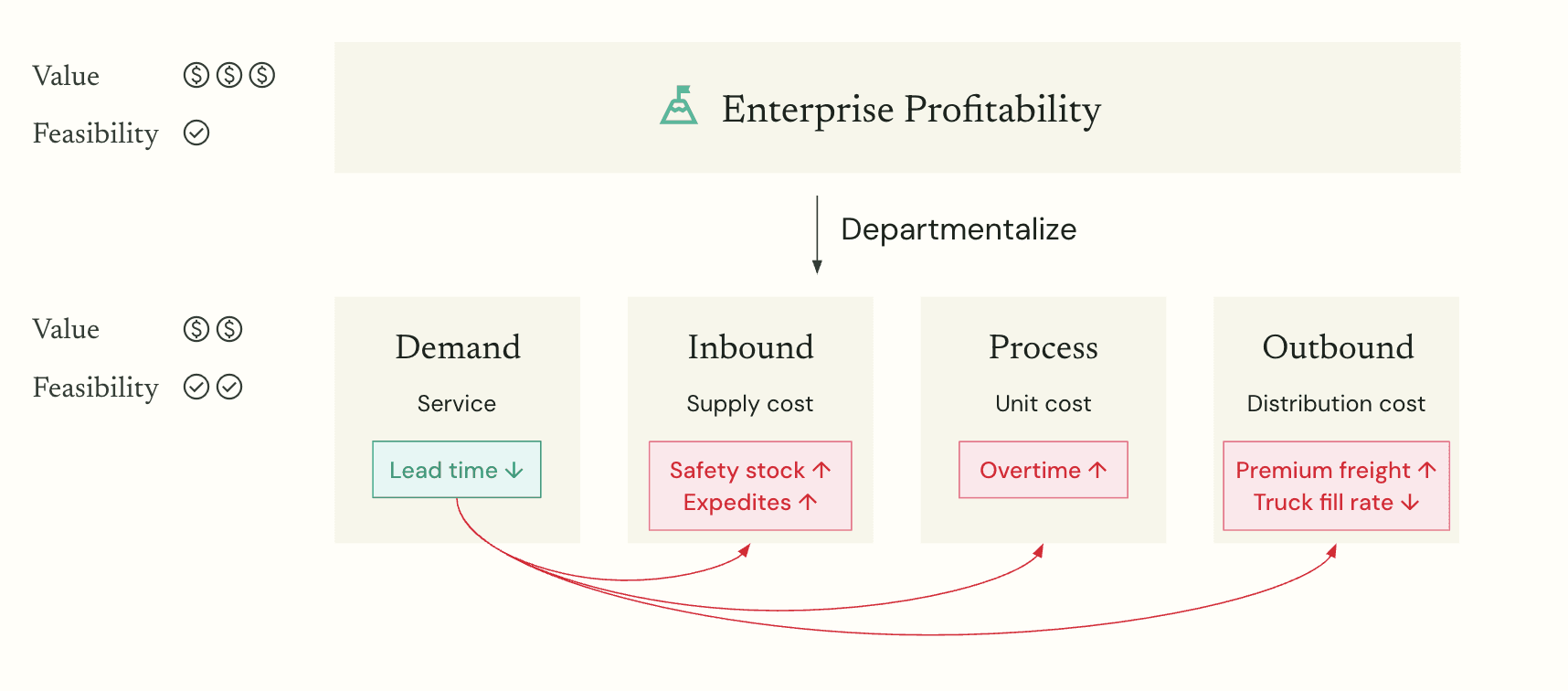
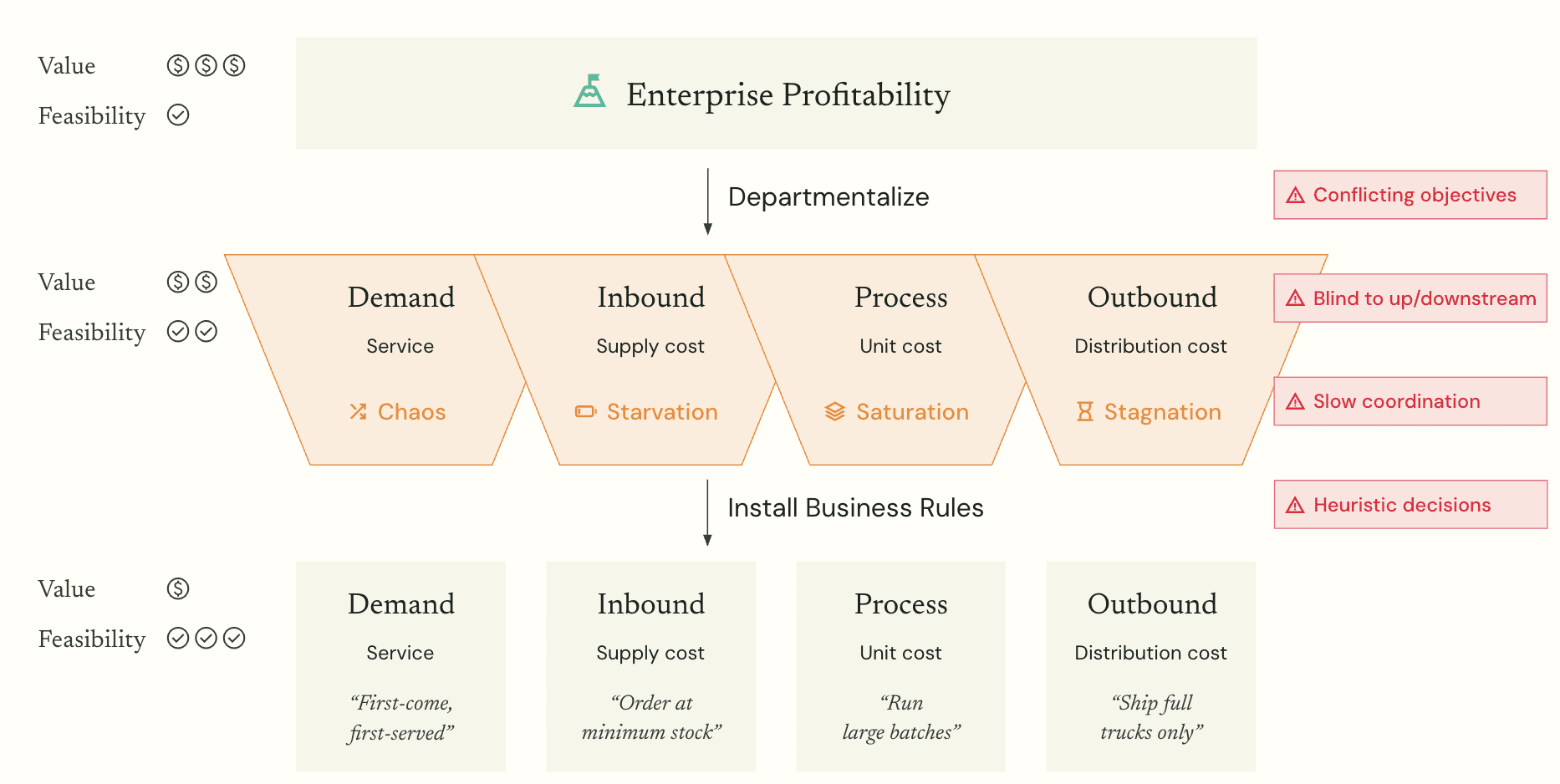
To cope with this complexity, enterprises organized themselves into departments. Such a structure enables accountability and focus at scale. However, Enterprise Profitability is not a meaningful target at the departmental level. What would it mean, for instance, for a Supply Chain or Production department to be “profitable”? These functions do not generate revenue directly, but operate within a cost and service mandate.
As a result, departments adopt surrogate objectives and focus on improving the metrics they control. This is what we typically refer to as Operational Excellence, commonly defined as ‘creating maximum value with minimal waste’. But it comes at a cost: to make the organization operationally feasible, enterprise-level optimality is traded for local manageability.
Even within departments, optimizing every decision directly for Operational Excellence is rarely feasible. Operations move quickly and involve too many variables. To manage the complexity of daily operations, teams rely on experience and intuition to define business rules: heuristics that approximate optimal decisions without requiring a full analysis each time. Over time, these rules become embedded in the department’s way of working and define its Operational Excellence.
These two approximations shape how organizations operate:
Enterprise objectives are translated into departmental KPIs
System-wide optimization is replaced by static heuristics
Together, these approximations make operations manageable, but introduce a structural limitation: a performance ceiling that cannot be overcome within traditional Operational Excellence.
In many leading organizations, this performance ceiling is already visible. Years of continuous improvement have significantly optimized performance within individual departments, leaving limited headroom for further gains at that level.
And because department-level efficiency gains have been exhausted, enterprises will have to look elsewhere for further improvements.
Reaching the next stage of operational performance requires a shift in how organizations coordinate decisions. This is where AI plays a meaningful role and can drive excellence through two distinct, complementary ways: automation and orchestration.
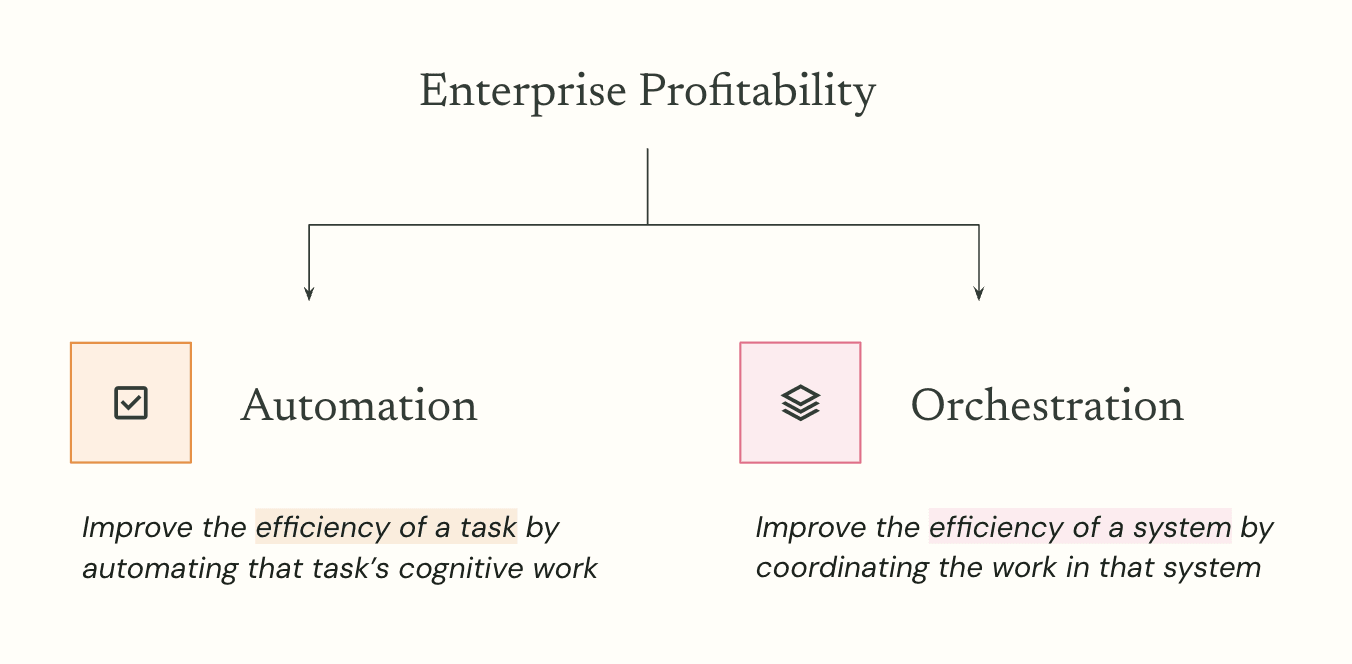
Automation improves the efficiency of individual tasks by partially or fully automating them.
A report can be generated automatically from internal data. An employee receives contextual information directly within their workflow. A manual operation on the shop floor is performed by a robot.
Over the past decade, these improvements have been meaningful. Automation has helped organizations make many operational tasks faster, more reliable, and less costly. In many cases, these improvements translate into 10–30% efficiency gains within the task itself.
However, these gains rarely translate into meaningful improvements in enterprise profitability. A single task, no matter how optimized, remains one element in a complex system of interdependent activities. As a result, local efficiency gains do not automatically translate into system-level performance improvements.
To improve enterprise profitability, the focus must shift from task-level efficiency to system-level coordination. This is where orchestration plays a critical role.
Orchestration operates at the coordination layer. Instead of improving individual tasks, it determines how tasks interact and are coordinated across the system.
In complex environments, performance depends not only on how efficiently tasks are executed, but on how coherently decisions across those tasks fit together.
AI systems are particularly well suited to this role. They can process large volumes of contextual information, evaluate trade-offs across many variables, and continuously update plans as conditions change. In many cases, improvements at this level can translate into 10–30% efficiency gains across the system, rather than within a single task.
When this coordination extends across the entire organization, aligning decisions, processes and teams around shared objectives, we refer to it as Enterprise Orchestration.
At Superlinear, we use it to describe a capability that becomes essential as organizations scale and operational complexity increases.
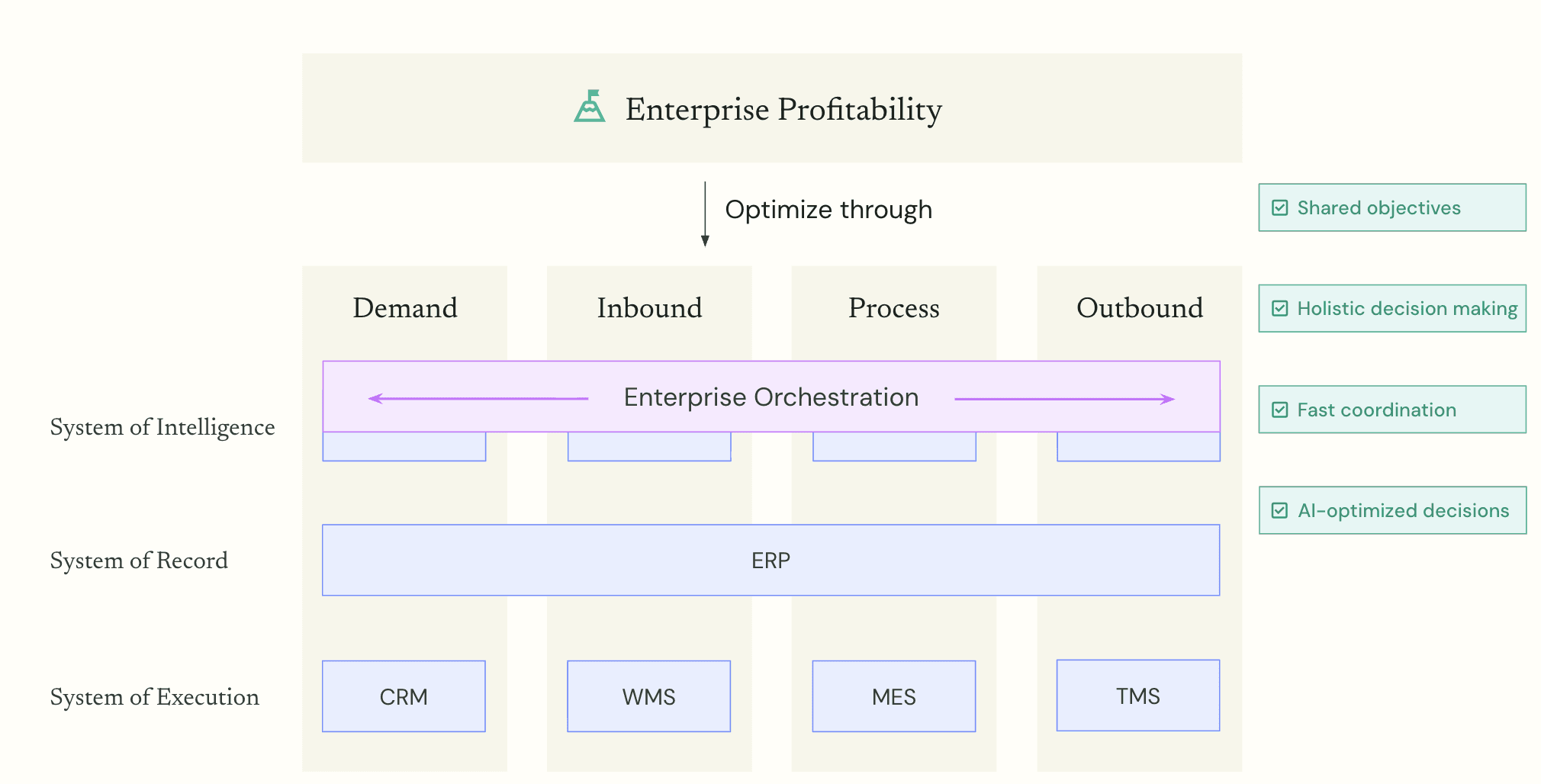
We define Enterprise Orchestration as the coordination of data, teams, processes, decisions and tasks across the enterprise around shared objectives such as Enterprise Profitability.
A useful analogy is an orchestra. Each musician may play their part perfectly, but without coordination the performance no longer works as a whole. The conductor does not replace the musicians, but his role is to align timing, interaction, and dynamics so the entire ensemble performs as one system.
Large organizations face a similar challenge.
In complex enterprises, decisions are deeply interconnected. A change in demand affects production plans. Production changes influence inventory levels. Inventory levels affect transport schedules, staffing needs, and service commitments. When these decisions are made independently, bottlenecks appear elsewhere in the system.
Enterprise Orchestration evaluates these decisions in the context of the whole system, and selects the plan that best serves enterprise objectives.
The objective is simple to state but difficult to achieve: to improve enterprise-level performance by coordinating decisions across silos rather than optimizing them in isolation.
Enterprise Orchestration creates value in two primary ways.
Enterprise Orchestration replaces static business rules with optimization grounded in real constraints and enterprise-level objectives. Decisions are evaluated using current data, system-wide context and explicit trade-offs rather than simplified heuristics.
This allows organizations to continuously compute the best possible decision given the current conditions, rather than relying on rules that are adequate but rarely optimal.
As a result, decision quality improves consistently rather than occasionally. Over time, small improvements across thousands of daily decisions compound into measurable gains in Enterprise Profitability.
At the same time, decision-making becomes faster and more proactive. Because decisions are coordinated across the system, organizations avoid repeated rework and conflicting adjustments between departments. Instead of reacting to downstream consequences, they anticipate them.
As decisions are continuously recalculated rather than hard-coded, organizations can respond faster to disruptions, adjust plans more frequently and evaluate alternative scenarios before committing.
Enterprise Orchestration evaluates decisions in the context of enterprise-level objectives, rather than solely through departmental KPIs. Trade-offs between cost, service, risk and capital become explicit and comparable across functions.
This creates end-to-end alignment by design. Actions in one department no longer optimize at the expense of another because their system-wide impact is visible.
Over time, this alignment strengthens the organization’s ability to absorb shocks and adapt without constant executive intervention. Resilience and agility become the natural outcome of decisions being evaluated within a shared enterprise context.
Ultimately, Enterprise Orchestration shifts the question from “Does this improve my KPI?” to “What is the net impact on enterprise profitability?”
Enterprise Orchestration marks a structural shift:
from siloed efficiency to enterprise-level optimization
from business rules to optimal decisions
from local KPIs to Enterprise Profitability
from task automation to system coordination
It enables complex organizations to operate as one coherent system.
Enterprise-wide orchestration is not a quick win. It is a strategic transformation affecting planning, tasks, decisions, processes, and people, and it requires both technical capability and organizational alignment.
For many leaders, the question is not whether orchestration creates value, but where to begin. Experience shows that progress depends less on starting small, and more on starting where leverage is highest, where coordination complexity and value potential intersect. Because the impact of better coordination compounds across the system, scope matters.
At Superlinear, we support organizations in designing and implementing enterprise orchestration platform, focusing on the areas where it creates the most value.